

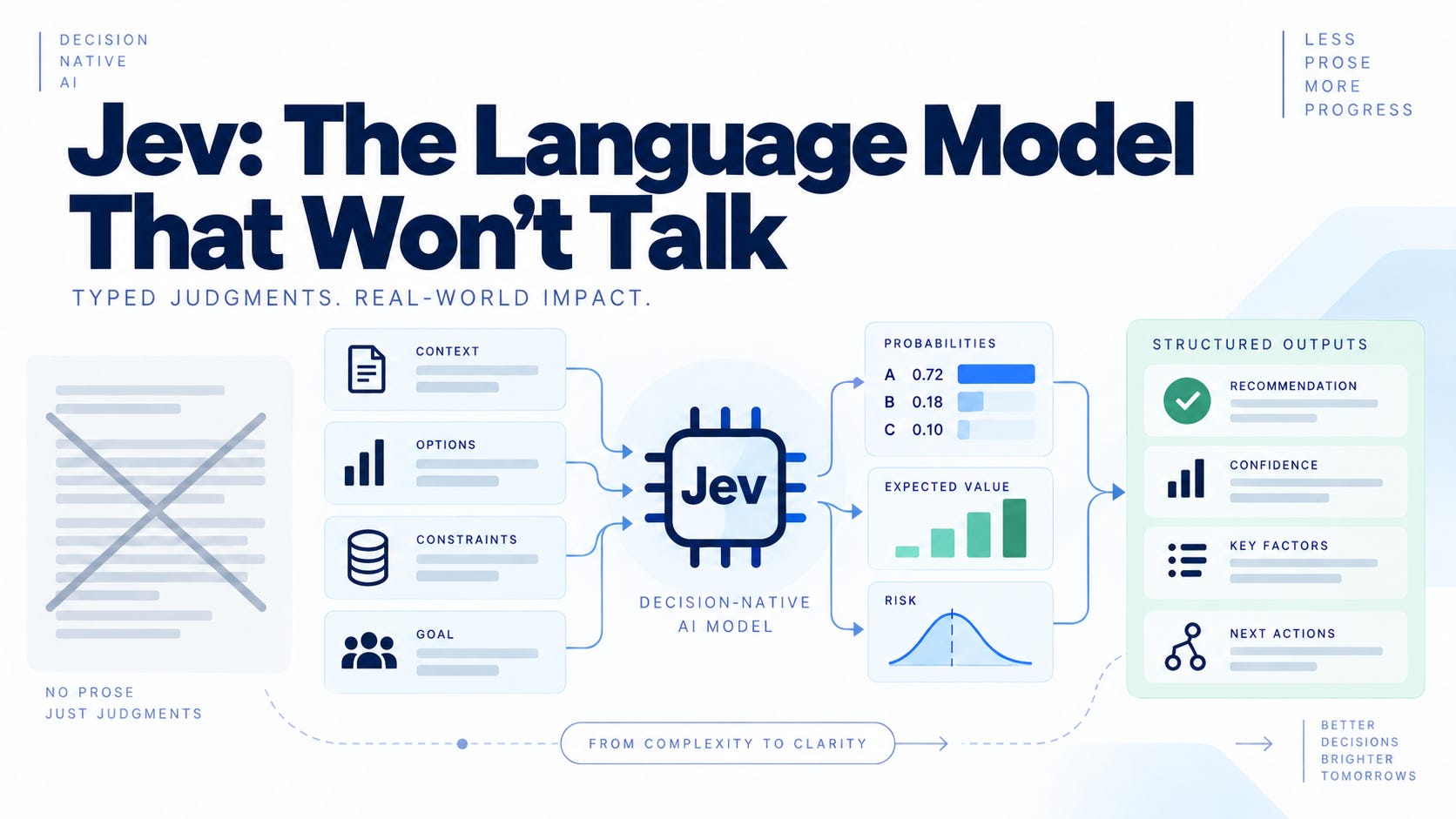
The interesting claim in Jev isn’t the price, although that promises to be a game-changer. It is that generating language may be the wrong interface between a model and the software that has to act on it. I think this is one of the most interesting developments in AI in 2026 already.
TypeSafe has built a model that cannot write an article, generate code, or explain itself. Output is unmetered because there barely is any. What comes back is a set of decisions and probabilities that ordinary code can consume without parsing anything.
That’s the feature; they are selling the limitation.
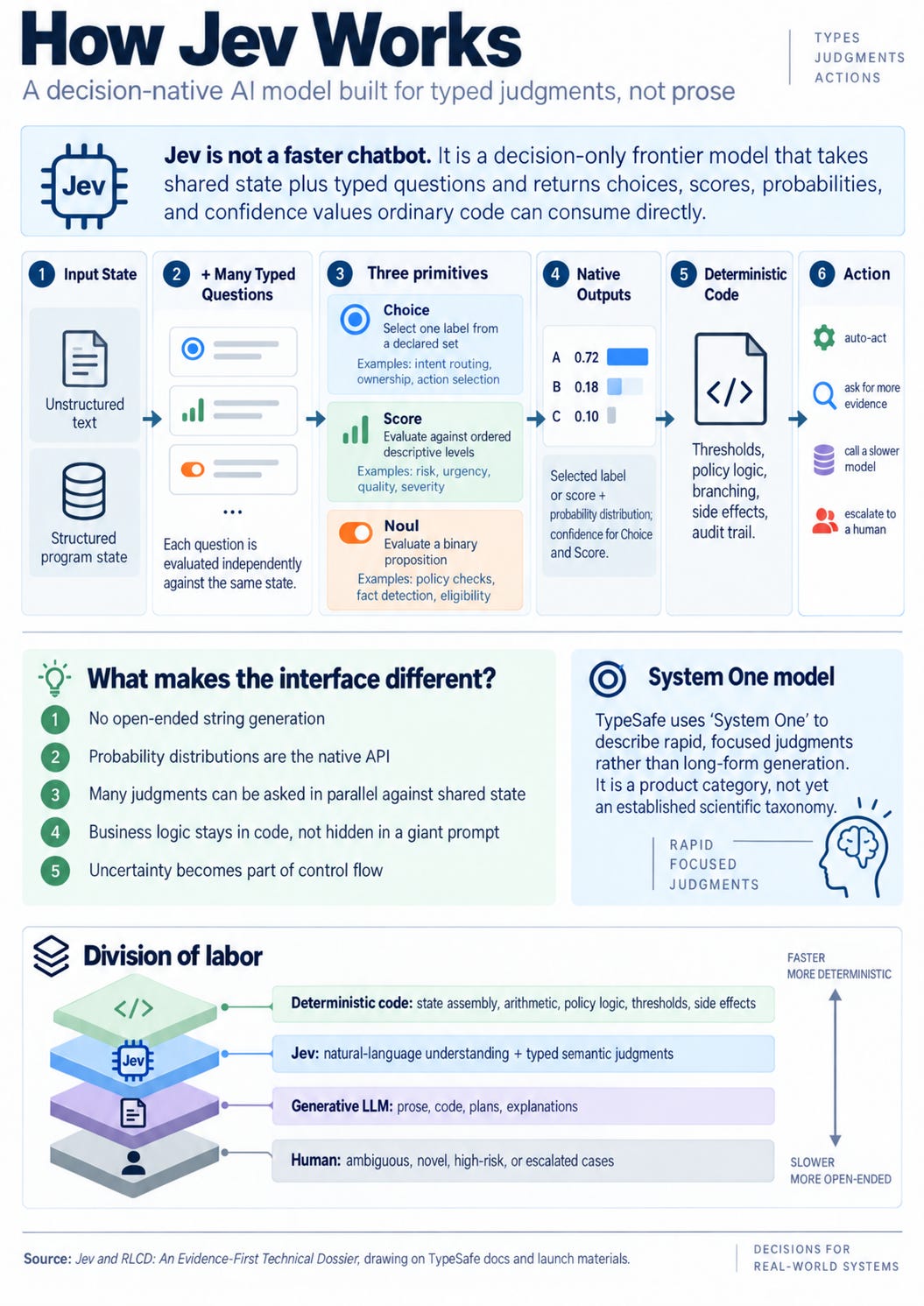
The model is called Jev. TypeSafe calls it a “System One” model, trained with something they call Reinforcement Learning for Calibrated Decisions, or RLCD. You hand it a shared state and several typed questions. It returns choices, scores, and probability distributions. There is no conversational answer to interpret and no rationale to strip before the application can branch on the result.
The obvious headline is cheaper, faster AI, and the launch invites it. The more consequential idea is about architecture. Maybe dependable automation wants models built to make bounded judgments inside software, instead of software wrapped around a model’s open-ended conversation. It is in selective early access right now. There’s a waitlist and a Discord on their page.
The Hidden Tax of Strings
I’ve always had a love/hate relationship with string as a software engineer, but this is slightly different. Take a support system that needs to know whether a customer is asking for a refund. With a generative model the application asks a question, gets back text or JSON, validates it, and turns it into a branch in the program. Structured outputs make that arrangement less painful, but the interface underneath is still generative. The application needs a decision. The model produces tokens that represent one, and the application has to trust the representation. .
Jev starts from the decision space instead. The API exposes three primitives: Choice picks from declared alternatives and returns their probabilities plus a confidence value. Score evaluates ordered descriptive levels and returns a continuous score, a distribution, and confidence. Noul evaluates a binary proposition and returns the probability that it is true. You can combine all three in one request against the same state.
So a support workflow might ask for the customer’s intent, their frustration level, and whether a refund was requested. Code then applies the refund policy, routes the ticket, or escalates it. The model supplies the semantic judgment and does not own the policy.
TypeSafe says those questions are evaluated independently and in parallel, with little added latency as the question count grows. I would want to see that measured by someone other than TypeSafe, but if it holds it changes the programming model. You decompose a broad task into narrow judgments and compose the results explicitly, in code you can read. Instead of asking a model to “handle this customer,” you specify what has to be understood and what happens afterward. Decisions, thresholds, and consequences become visible parts of the application.
Who & What
The person making this argument is Diogo Almeida and he’s got serious street cred. He helped build the training approach that played a foundational role in making conversational assistants more aligned and useful in the first place.
The TypeSafe founder was an equal-contribution primary author of the InstructGPT paper and contributed to GPT-4. That is more accurate than the company’s “co-inventor of ChatGPT” positioning in some of the hype material on X today, and it gives his critique weight without collapsing a collective effort into one guy.
His argument separates three objectives:
Reinforcement learning from human feedback, RLHF, optimizes for what humans prefer.
Reinforcement learning with verifiable rewards, RLVR, optimizes against outcomes you can check.
(new!) RLCD is supposed to optimize decisions so that their probabilities match how often they turn out to be right.
That distinction is practical, I rather expected it to be academic. An assistant can give an answer people like without giving software any reliable basis for deciding when to act on it. Automation needs uncertainty that can govern behavior, and reassuring language isn’t that. This has always been part of the “fun” of working with LLMs. Almeida’s pre-launch thesis, however, was that a different training objective should produce a different API, and Jev is what that thesis looks like as a product.
“System One” is TypeSafe’s category, in other words, it’s a new idea. I would describe it as a learned semantic branch instruction, a component that handles fuzzy judgments while deterministic code stays in control of execution. Pretty cool.
What’s Calibration?
Calibration has a specific meaning in this context. Across many predictions the model assigned an 80 percent probability of being correct, roughly 80 percent should be correct.
This is the key point right here: it describes a population of predictions. It doesn’t tell you whether one particular answer is right.
You’re probably thinking that it also doesn’t establish usefulness. You’re right. A model that always predicts the base rate can be perfectly calibrated and contribute nothing to any individual decision. Accuracy still matters, and so does the ability to tell easy cases from hard ones.
Jev adds a wrinkle. For Choice and Score, the separate confidence value is derived from the shape of the returned distribution. A concentrated distribution means higher confidence. TypeSafe has not said which statistic. Concentration on its own isn’t evidence that a prediction deserves trust in your particular deployment.
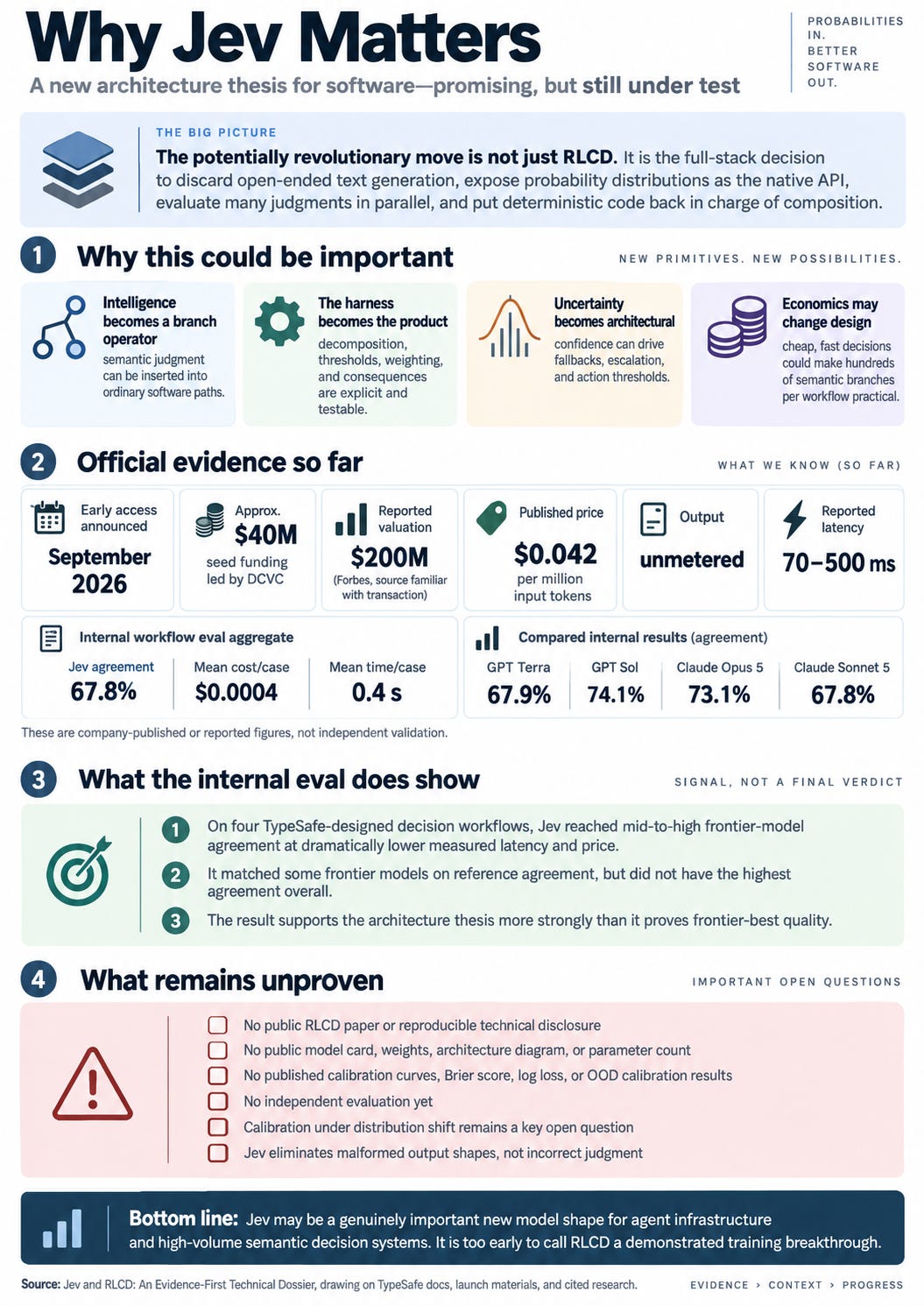
I know it’s a little convoluted to follow, but I’m working from secondary sources and trying to apply my domain knowledge to smooth this out into a preview that doesn’t overclaim. As of September 15, 2026, TypeSafe has described what RLCD is meant to do without publishing enough for anyone to evaluate it as an algorithm. The reward function, architecture, training procedure, and calibration methodology are all undisclosed. There are no published calibration curves and no independently reproducible paper.
Something worth clarifying: Reinforcement learning for calibration is also not new. Work like “Rewarding Doubt” already explores rewarding models for calibrated confidence. What could set Jev apart is the whole package: no open-ended generation, typed distributions as the native output, and a product organized around parallel decisions.
I don’t imply this takes something away from Jev, taking experiments and research from the lab and building it into that product that people will pay for has been a challenge for many in this domain. Even the big boys are strugging with “tokenomics” and the shortage of compute infrastructure making many AI endeavors unprofitable or beholden to latency issues. I know this first hand. Jev appears to change this by orders of magnitude. Seriously.
What the Numbers Show
TypeSafe’s internal evaluation covers four workflows: security incident response, agent-trace observability, invoice processing, and customer service.
Across those four, Jev averaged 67.8 percent agreement with the reference answers, at a reported $0.0004 and 0.4 seconds per case. The comparison labeled GPT “Terra” reached 67.9 percent at $0.0304 and 10.1 seconds. Claude Sonnet 5 also landed at 67.8 percent, at substantially higher reported cost and latency.
Those are striking numbers inside the experiment. They are not evidence that Jev matches the strongest models on every decision task, because it didn’t. GPT “Sol” hit 74.1 percent aggregate agreement and Claude Opus 5 hit 73.1. Invoice processing had the widest gap, Jev at 61.8 percent against Sol’s 79.1. If the mistake is an expensive one, that quality difference could matter a lot more than the inference bill.
The methodology also limits what “agreement” means here. The reference labels came from averaging GPT-6 Astra and Claude Fable 5.1 at high reasoning settings, not from independent operational ground truth. TypeSafe designed the workflows and acknowledged possible design bias. Its largest advertised speed and cost advantages were described as probably near the upper end of what you would see in the real world.
The defensible conclusion is narrow but real. Jev performed competitively on selected decision workflows at much lower measured price and latency. The evaluation did not establish probability calibration, general intelligence, or production reliability.
One more result deserves attention. Averaged across the four tasks, every comparison model got more accurate, faster, and cheaper when placed inside an explicit workflow instead of being asked to execute the whole policy through one prompt. Before the experiment makes an argument for Jev, it makes an argument for decomposition.
A valid answer can still be wrong TypeSafe’s claim that Jev “can’t hallucinate” needs a firm qualification.
When the possible outputs are declared in advance, the model cannot invent an undeclared field or produce malformed output. That removes a real class of integration failures. It does nothing to stop the model from picking the wrong option, misreading the evidence, or assigning an unjustifiably high probability to a bad answer. Jev constrains the shape of the output. It does not constrain the judgment.
A badly designed schema makes that worse. When the correct answer isn’t among the choices, probability still has to land somewhere among the options that remain. Developers need real routes for “unknown,” “none of the above,” and “insufficient evidence,” instead of assuming uncertainty will always announce a broken question.
Calibration also depends on the deployment distribution. Changed policies, unfamiliar customers, new fraud patterns, or adversarial inputs can quietly undermine probabilities that were reliable last month. And individually calibrated judgments do not automatically compose into a calibrated workflow once you run them through thresholds, weights, and branches. Correlated mistakes survive composition.
So the business question is what error rate you are left with at a useful level of autonomous coverage, for a particular action. Routing a help request and authorizing an irreversible transaction should not share a confidence threshold.
The harness gets more important, not less For agent engineering, Jev’s strongest prospective role is in the control layer around the agent: selecting tools, grading traces, detecting loops, checking completion, and deciding when to escalate.
That implies a division of labor. A generative model drafts, plans, or explains. Jev supplies bounded semantic judgments. Code handles state, arithmetic, policy, permissions, and side effects. Humans take the ambiguous or high-risk cases. The intelligence gets spread across the system instead of trusted to one conversational loop.
Economics could make that practical in more places. TypeSafe’s published early-access price is $0.042 per million input tokens, with output unmetered. Launch materials report responses in the 70 to 500 millisecond range. Both are provider-reported, and a selling price says nothing about sustainable serving cost or how the thing behaves under production load.
Still, the design implication is real. When a semantic check is cheap and fast enough, an application can afford to do a lot of them: around each tool call, across every trace, before each consequential action. The name is a nod to Jevons paradox, where making a resource more efficient increases its total use. TypeSafe is betting on more machine judgment, not on cheaper chatbot calls.
The trade-offs do not go away. A probability-only interface gives you no explanation. Systems that need evidence, appeals, or debugging have to preserve supporting information or bolt on an explanation layer. Thresholds may end up coupled to one model version’s distributions. The harness has more explicit responsibilities, which is the opposite of what “just call the model” people were hoping for.
The burden of proof Jev deserves independent testing on decision quality, calibration under distribution shift, and latency as the question count grows. Evaluators should measure whole workflows, fallback models and human review included, rather than treating one cheap API call as the unit of cost.
Until that happens, the strongest case for Jev is architectural rather than algorithmic. It proposes that language generation stop being the default interface for every encounter between intelligence and software. Some tasks need a paragraph. Others need a bounded decision, usable uncertainty, and an explicit account of what happens next.
Whether RLCD delivers on that is unproven. The question the product asks is still a good one: how much more dependable could AI get if we stopped requiring every intelligent component to talk?
Save these JEV resources. Thank me later.
- Demos & use cases: madewithjev.com
- What is JEV: madewithjev.com/what-is-jev
- Tools: madewithjev.com/tools
- GitHub repos & skills: madewithjev.com/categories/agents-and-browsers
- Awesome-JEV repo: github.com/kraayenjon/awesome-jev
The person-facing part deserves a demo too. Can someone see how their request was categorized and correct it with one click? That would make the classification useful feedback for the next version of the workflow, as well as a decision made behind the scenes.