The Shell Game: How OpenAI Built a $125 Million Super PAC and Insists It Has Nothing to Do With It

OpenAI’s chief global affairs officer sits on the board of the company that built the $193 million crypto-industry political machine he is now reportedly running for AI. OpenAI insists the new PAC has nothing to do with the company.
The chief global affairs officer of OpenAI sits on the board of Coinbase. He joined the Coinbase board in July 2024 and took the OpenAI job a month later. He has not resigned from the Coinbase board since (Wikipedia).
That sentence is the whole story.
Coinbase is the founding funder of Fairshake, the crypto industry super PAC that spent $193 million through the 2024 cycle taking out federal candidates who supported crypto regulation. Fairshake is the explicit template for Leading the Future, the $125 million pro-AI super PAC network that launched in August 2025 with one goal: kill state-level AI regulation and put the industry’s critics out of office. The same operatives. The same advisor. The same playbook. New industry.
The chief global affairs officer is Chris Lehane. He helped build Fairshake while at Coinbase. He was in the room helping design Leading the Future after he joined OpenAI (Wall Street Journal). He sits on the board of the company that funded the template his current employer is using, and not as a former director who left when he changed jobs. Currently. As of this writing he is a fiduciary of Coinbase and a senior executive at OpenAI, simultaneously, while the operational template that benefited Coinbase is being run by the same network of operatives on behalf of OpenAI’s competitive position.
OpenAI says Leading the Future has nothing to do with the company. Lehane himself, on the record this spring, called the PAC “an independent thing that runs on its own.” OpenAI put out a statement saying it would not be donating to political committees because it wants to keep its political spending under direct oversight (Yahoo Finance / CNN).
The arrangement is technically true and structurally ridiculous. OpenAI’s corporate balance sheet does not contain a donation to the PAC. OpenAI’s president funds it personally to the tune of $50 million and counting. OpenAI’s policy chief was in the room helping design it. The man running it day to day was the spokesperson for the previous version of the same template. The dark-money sister organization is funded by donors who do not have to be named. And the policy chief who is supposed to be a neutral observer of all this is, simultaneously, a fiduciary director of the company that funded the previous version. He owes Coinbase a duty of care. He runs policy for OpenAI. Both companies benefit from the same operational playbook. We are asked to believe these are separate concerns.
This is what that looks like when you actually trace it.
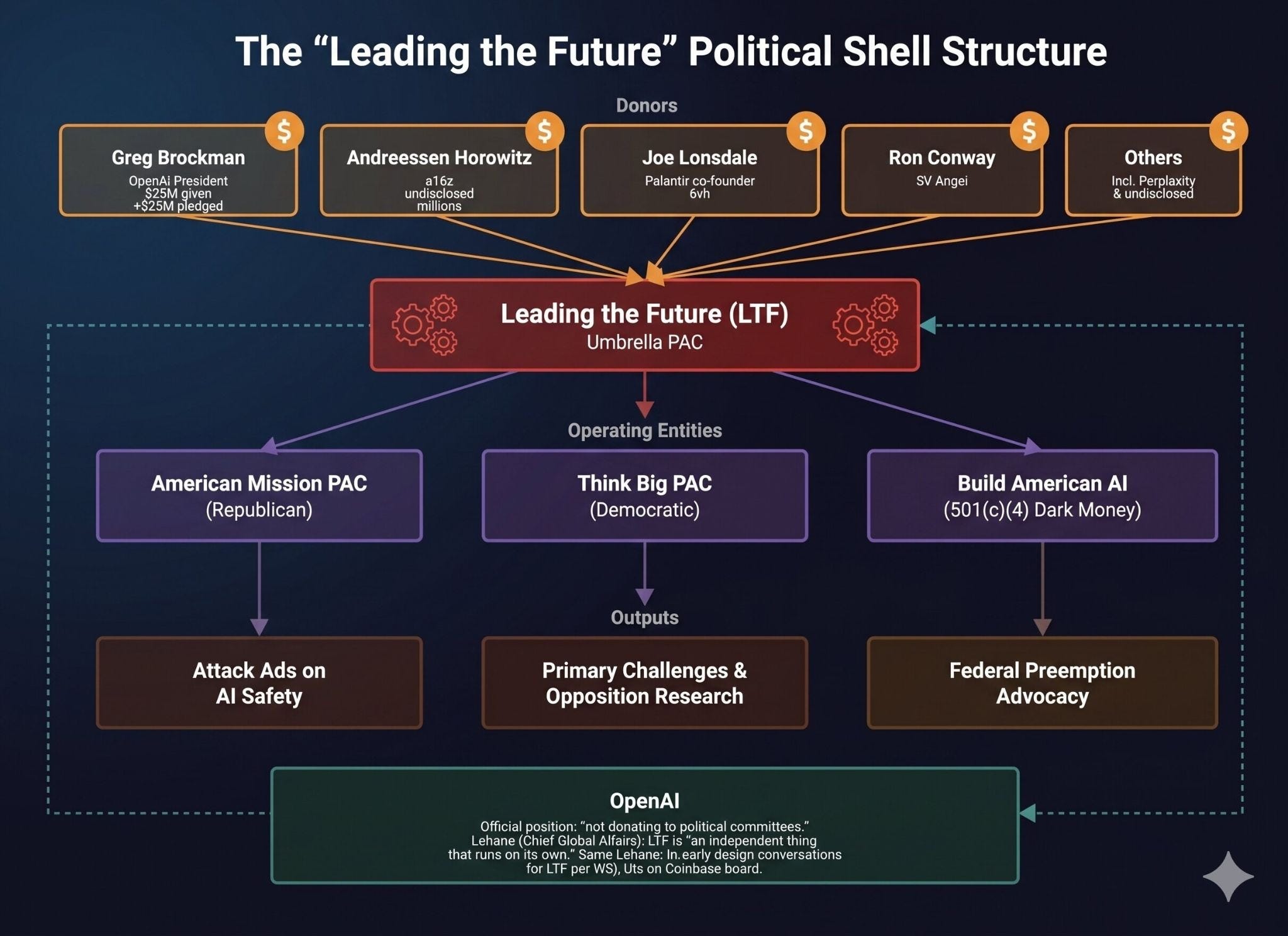
The structure on paper. Five donor pools feed an umbrella PAC, two partisan attack affiliates, and a dark-money 501(c)(4). OpenAI sits outside the diagram on the corporate filings -- and inside every conversation that built it.
The Coinbase board seat is the load-bearing fact
Start here, because everything else flows from it.
Chris Lehane is a sitting member of the Coinbase board of directors. He has been since July 2024. The board seat is current. Coinbase has not announced his departure. Lehane has not announced his departure. He is a director, today, while running OpenAI’s global affairs operation.
In most regulated industries this arrangement would be illegal or very close to it. A senior executive of one company sitting on the board of another company whose business strategy is intertwined with the first company’s policy environment runs into conflict-of-interest restrictions almost immediately. Banking regulators forbid most directors from sitting on competing bank boards. Securities regulators require disclosure and recusal regimes for exactly this kind of overlap. The Sherman Act has been applied to interlocking directorates that distort competition. The reason these rules exist is simple.
Fiduciary duty is not a vibe.
It is a legal obligation to act in the interest of the company whose board you sit on, full stop. You cannot be a fiduciary of two companies whose interests intersect and pretend the intersection does not exist.
AI is not yet a regulated industry in the United States. Coinbase is regulated as a financial services company, but Lehane is not a Coinbase officer or compliance professional. He is a board member who advises on strategy. The strategy he advised on at Coinbase produced Fairshake. The strategy he is currently advising on at OpenAI produced Leading the Future. The two strategies are the same template. The two companies have overlapping financial interest in the success of that template. Coinbase already won its policy fight using it. OpenAI is trying to win its fight using the same approach.
When the press has asked about this, the answers have been thin. OpenAI’s official position is that Lehane discloses his outside activities to the company. That statement addresses nothing. Disclosure is not recusal. Sitting on a board and not voting on a particular item is not the same as not benefiting from the policy work that flows from that board’s strategic decisions. Coinbase has not commented on whether Lehane recuses from anything. Lehane has not commented on whether he recuses from anything. The arrangement is opaque by design.
If this were any other policy domain -- if the executive in question were running healthcare lobbying while sitting on a pharma board, or running banking policy while sitting on a Wall Street bank board -- the arrangement would generate days of coverage and a Senate committee letter. Because it is AI policy, and because AI policy is new and the press is still calibrating what to scrutinize, it has generated almost none.
The relevant question is not whether the arrangement is technically legal. It is. The relevant question is what it tells you about how OpenAI thinks about political strategy. They hired the architect of the crypto industry’s PAC machine, kept him on the board of the company that funded that PAC, and then claimed it was a coincidence when the same operatives showed up running a parallel operation for the AI industry. The personnel pipeline runs through one person who is paid by both companies. We are asked to believe these are separate concerns.
The template the Coinbase board funded
Fairshake is the crypto industry’s super PAC network. Coinbase was its founding funder. Lehane helped create and run it while he was chief strategy officer at Haun Ventures and an adviser to Coinbase (Axios on Lehane’s CV). It collected roughly $193 million through the 2024 cycle and another $116 million-plus heading into 2026, with major contributions from Coinbase, Ripple, and Andreessen Horowitz (Politico). It spawned partisan affiliates -- Defend American Jobs for Republicans, Protect Progress for Democrats -- and used them to drown anti-crypto candidates in negative spending (The American Prospect).
Leading the Future has the same structure. The headline brand is bipartisan. The actual spending flows through two partisan affiliates, American Mission PAC and Think Big PAC, which had $5 million and $5.4 million in cash respectively as of January 2026 (Axios). It has a 501(c)(4) dark-money nonprofit attached, Build American AI, that does not have to disclose its donors and is running its own eight-figure ad campaign on policy (Axios). The donor list looks familiar too: Andreessen Horowitz, Joe Lonsdale of Palantir/8VC, Ron Conway of SV Angel, and a notable AI startup named Perplexity all show up on both the LTF disclosures and the broader Lehane orbit (Axios).
Transformer News, in a long investigation published in March 2026, was direct about the connection: Leading the Future was “created with Lehane’s input and modeled after the pro-crypto PAC he started” (Transformer). The WSJ exclusive announcing LTF named the people in the room: Brockman, Lehane, and Collin McCune from Andreessen Horowitz. The Information separately reported that Lehane “provides informal advice” to the PAC. The template was not just borrowed. It was copied by the same designer.
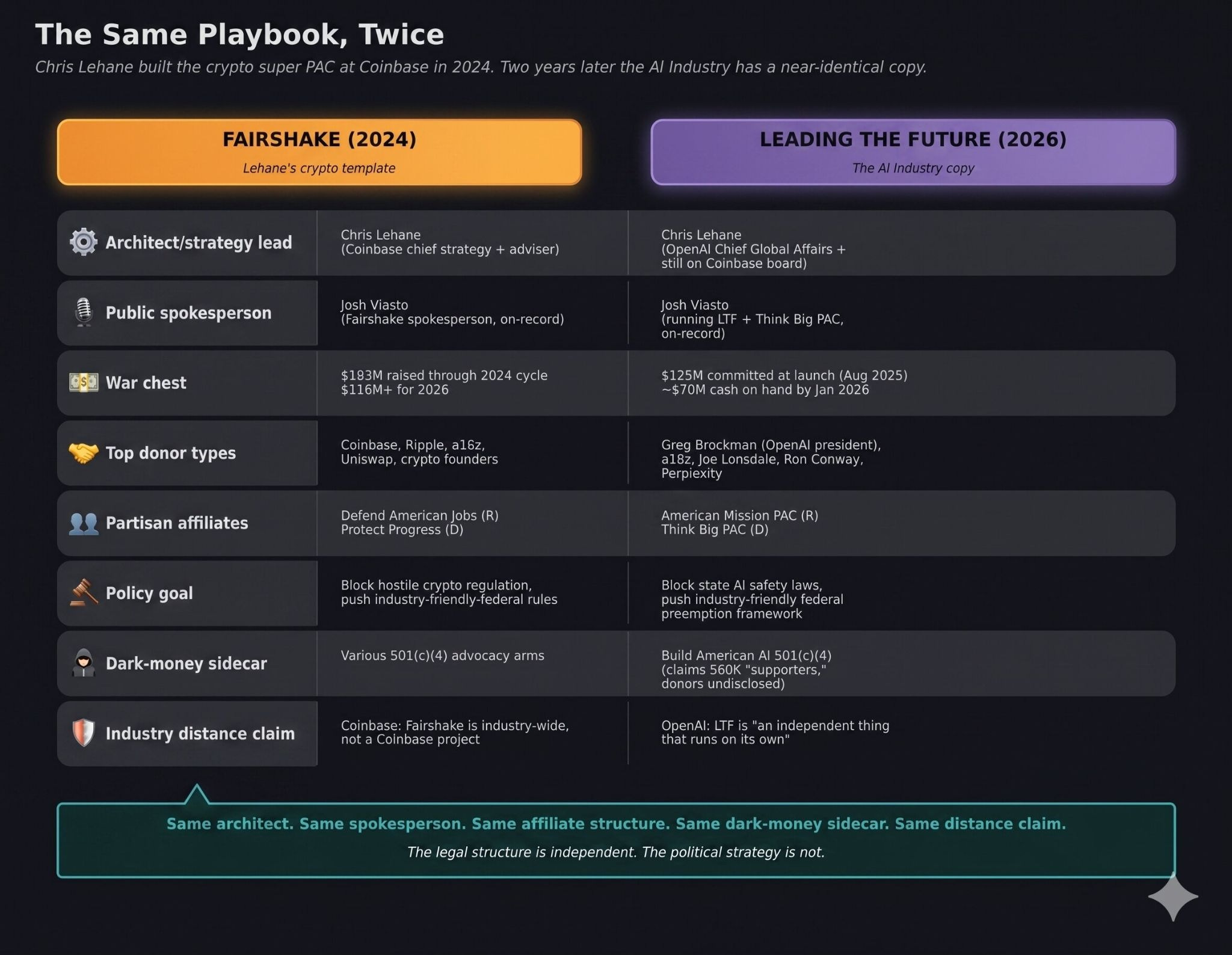
Same architecture, two industries, two years apart. Bipartisan umbrella, partisan attack affiliates, dark-money sister organization, eight-figure ad budgets pointed at the legislators most likely to slow the industry down.
What Fairshake actually did to its enemies
The reason the Fairshake template is worth taking seriously is that it worked. The crypto industry’s PAC network entered the 2024 cycle as an experiment. It exited as the single most successful single-issue super PAC operation in recent American political history.
Here are the specifics, because LTF is going to run the same plays.
In the Maryland Senate Democratic primary, Fairshake dropped roughly $10 million against Rep. David Trone, a crypto skeptic. Trone lost to Angela Alsobrooks. In the California Senate Democratic primary, Fairshake spent heavily against Rep. Katie Porter -- another crypto critic -- and helped push her into third place behind Adam Schiff and Steve Garvey. In Ohio’s Republican Senate primary, Fairshake spent more than $40 million to help Bernie Moreno, a crypto-friendly candidate, defeat establishment opponents. In New York’s 16th Congressional District, Fairshake piled onto the AIPAC-funded effort against Rep. Jamaal Bowman, contributing to a Democratic primary loss that no House incumbent had taken in years.
The pattern was the same in every race. Find a federal candidate who had voted against crypto interests or supported regulation. Drop seven or eight figures of negative spending in their primary. Don’t bother fighting the general. Take them out before they could win the nomination.
Fairshake did not need to win every race. It needed to make crypto opposition a career-limiting move for any politician who paid attention. By the end of 2024, that lesson had been delivered. The industry got most of what it wanted in the 2025 legislative cycle, including stablecoin legislation that had been stalled for years.
Leading the Future is following the same playbook with one adjustment. Instead of waiting for the federal cycle and going after general-election candidates, it is starting at the state level and going after the primaries first. A year out from the election. Against a state assembly member who has not yet been to Congress. Bores is the test case. If the playbook works in a deep-blue Manhattan district primary against a 33-year-old in his first congressional run, it will work anywhere, against anyone.
Lehane: the connective tissue
The way the Fairshake template became the Leading the Future template is through one person.
The Wall Street Journal’s exclusive announcing Leading the Future named three people in the early conversations that produced it: Greg Brockman, Chris Lehane, and Collin McCune. Transformer’s reporting and The Information’s subsequent reporting both place Lehane in an active advisory role at the PAC. When Transformer asked OpenAI about Leading the Future, the company directed all questions to the PAC. The PAC did not respond (Transformer). That is the playbook in miniature. The company points at the PAC. The PAC stays quiet. The donor money continues to flow.
Lehane is not a random political consultant. The New Yorker, in a long 2024 profile, called him a master of the “political dark arts,” documenting his career from Clinton White House opposition researcher to Airbnb’s regulatory enforcer to architect of the crypto industry’s Fairshake super PAC. The New York Times has been using similar language about him since at least 2004, when a profile of his work for Wesley Clark described him as such a shrewd practitioner of negative oppo that rival campaigns would automatically blame him whenever an unflattering story landed (New York Times). He earned the nickname “master of disaster” working for Bill Clinton (New York Times). He has since co-authored a book by the same name.
In the Punchbowl interview where he called Leading the Future “an independent thing that runs on its own,” Lehane was also asked to name any policy area where OpenAI and the PAC actually disagree. He could not. He said the LTF agenda “would be ideal if you could wave a magic wand.” That is not the way you describe an independent organization that happens to share some of your priorities. That is the way you describe your own wish list.
A man like that does not end up uninvolved by accident. If Leading the Future is independent from OpenAI, that independence was constructed by him, and constructed deliberately.
Brockman: the donor on top of the structure
The structure Lehane designed needs activation capital. Greg Brockman provided it.
In September 2024, Greg Brockman and his wife Anna gave $25 million to MAGA Inc., the super PAC supporting Donald Trump’s reelection. They gave another $25 million to Leading the Future. A source with direct knowledge of the matter told WIRED that the Brockmans have committed an additional $25 million to LTF in 2026 (WIRED).
For context on how out of pattern this is: Brockman’s largest previous political contribution on record was a $5,400 donation to Hillary Clinton’s 2016 campaign. He went from $5,400 to $75 million in committed political giving in eighteen months. He is also the president of OpenAI, the co-founder, and a member of the executive team.
That $75 million figure puts him in roughly the same tier as the handful of nine-figure individual donors who shape national elections -- Miriam Adelson, Tim Mellon, Ken Griffin -- people who have been giving at this scale for years and have entire political identities organized around their checkbooks. Brockman built his at-scale political identity in eighteen months. He went from a functional non-donor to one of the largest single-individual political funders in the country, in less time than it takes to ship a new model.
In the WIRED interview, Brockman did not pitch this as a personal political awakening separate from his job. He pitched it as job-aligned. His exact framing: “This mission, in my view, transcends companies and corporate frameworks.” He said the donations are in service of OpenAI’s founding goal of building advanced AI and distributing the benefits to humanity (WIRED).
Read that sentence twice. The president of OpenAI says his $50 million in donations to a “bipartisan AI super PAC” is in service of OpenAI’s mission. Then OpenAI says the same PAC has nothing to do with OpenAI.
Vlasto: the operator who came with the template
The architecture has a designer (Lehane) and a funder (Brockman). It also has an operator. The operator is the same person who ran the previous version.
Leading the Future is led by two people: Zac Moffatt and Josh Vlasto (Wikipedia). Vlasto is the public-facing operative. When City & State reported on LTF’s attack ads against Alex Bores, the on-the-record quote came from Vlasto, who they identified as “working with both Leading the Future PAC and Think Big PAC” (City & State).
Vlasto’s previous job: spokesperson for Fairshake. When Politico covered Fairshake’s $193 million war chest in January 2026, the statement defending the PAC came from “a spokesperson for Fairshake, Josh Vlasto” (Politico). His own LinkedIn post from January 2025 announced Fairshake’s $116 million haul on behalf of the PAC, listing Coinbase, Ripple, Uniswap, and Andreessen Horowitz as backers (Josh Vlasto LinkedIn).
The operating chain reads: Lehane builds Fairshake at Coinbase. Vlasto becomes Fairshake’s spokesperson. Lehane moves to OpenAI while keeping his Coinbase board seat. A new PAC appears, modeled on Fairshake. Vlasto turns up running it. The Coinbase board seat is still in place. We’re supposed to believe these are unconnected projects.
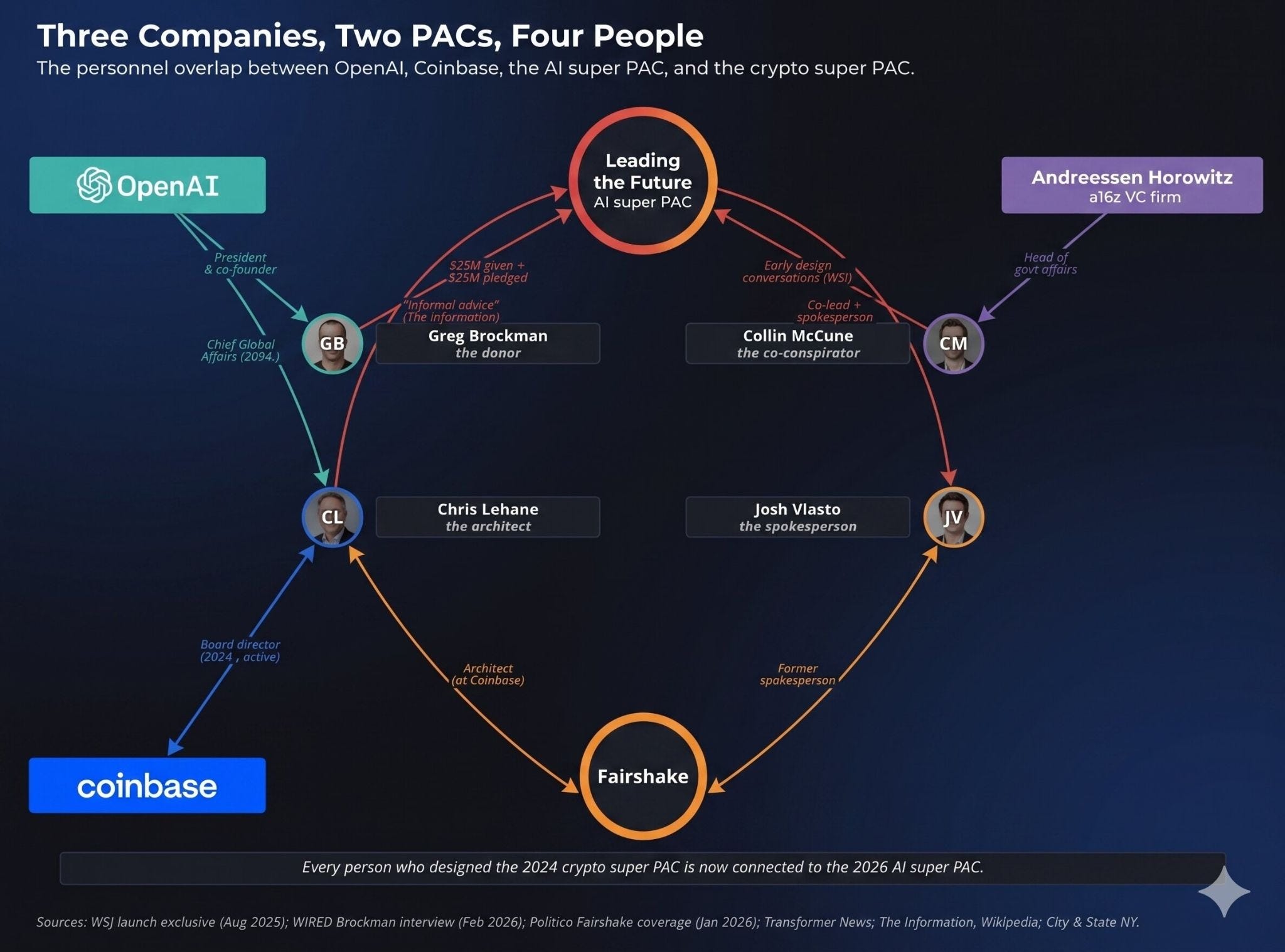
Three companies, two PACs, four people. The 2024 crypto super PAC and the 2026 AI super PAC share a designer, an operator, and a board seat. Lehane is still a Coinbase director while running global affairs at OpenAI.
The first target is Alex Bores
Alex Bores is a 33-year-old New York State assembly member running for Jerry Nadler’s old House seat. Before politics he was a Palantir engineer who, by his own account, left because of the company’s ICE contract (Transformer). In Albany he was the lead sponsor of the RAISE Act, a state AI safety bill aimed at frontier model developers (NOTUS).
Leading the Future opened on him more than a year before the midterms. Think Big PAC, the Democratic-side LTF affiliate, has already recorded $446,000 in TV and digital ads against Bores -- $120,000 in December 2025 and another $326,000 in January 2026 (City & State). The ads accuse him of “enabling ICE and powering their deportations” by working at Palantir and selling its tech to ICE.
Hold that next to the donor list. Leading the Future is funded in part by Joe Lonsdale, co-founder of Palantir. The PAC attacking a politician for once working at Palantir is funded by the man who co-founded Palantir. When City & State asked Vlasto about that, he said Lonsdale’s money went to American Mission PAC (the Republican affiliate) rather than Think Big PAC (the Democratic one running the Bores ads). A federal-filing distinction, technically true, and politically meaningless. It is the same network, the same staff, the same office.
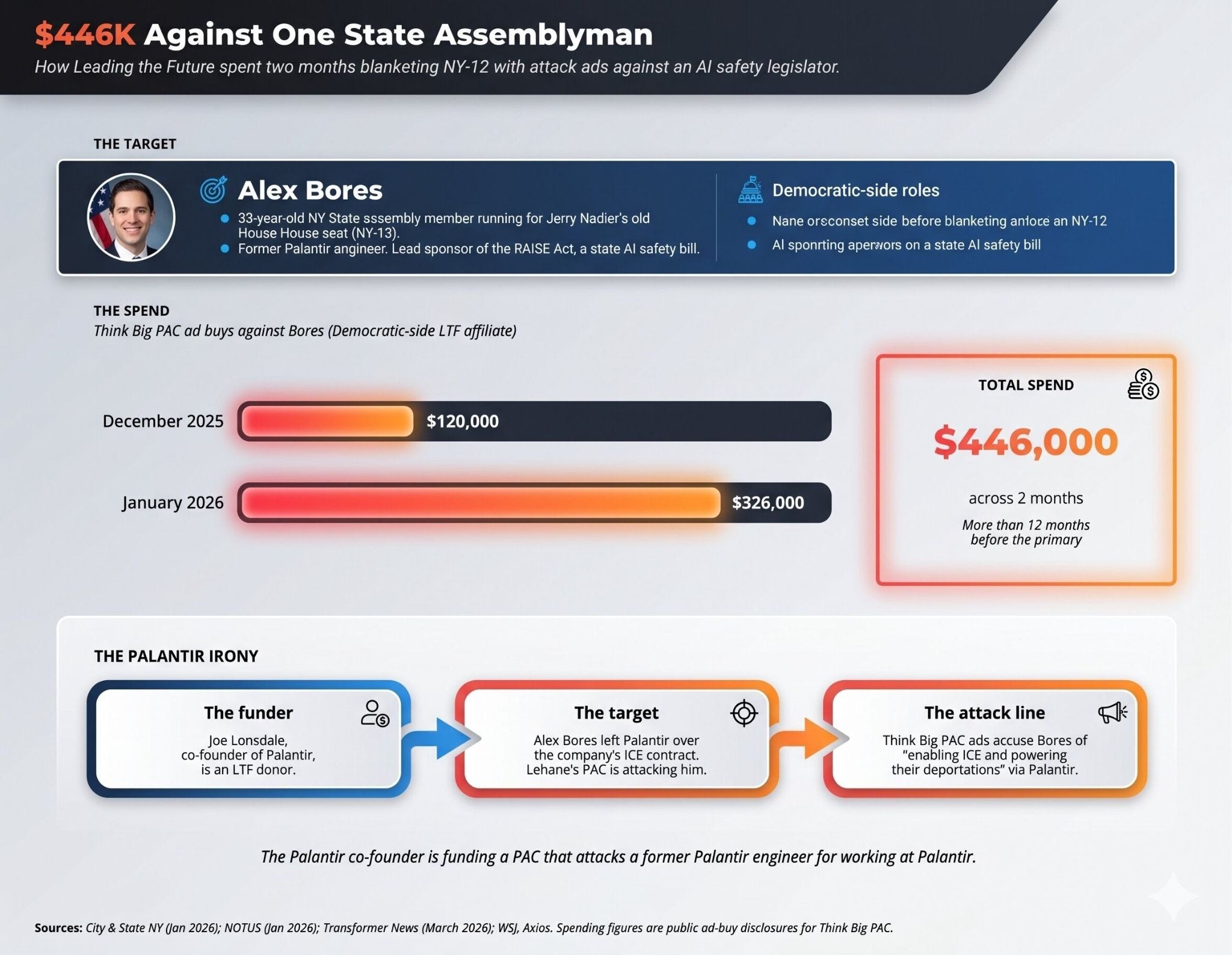
$446,000 against one state assemblyman, more than a year before his primary. Funded in part by the man who co-founded the company the ads accuse him of having worked for.
Bores’ team has called the ads “false and defamatory” and sent a cease-and-desist letter. Think Big PAC kept airing them. Vlasto’s response on the record was to call Bores a hypocrite “posturing for political gain” who wants to “hand AI oversight to Albany bureaucrats to appease his ideologically motivated doomer supporters.”
The phrase “ideologically motivated doomer supporters” is worth pausing on. That is not generic political ad copy. That is industry insider language -- the kind of thing a frontier lab’s policy team would say about AI safety advocates. Coming from a PAC that is supposed to have nothing to do with OpenAI, it reads less like an independent voice and more like an internal Slack message leaking through the press release.
There is a piece of context the ads also leave out. Bores is running in NY-12, a deep-blue Manhattan seat being vacated by Jerry Nadler. The Democratic primary effectively decides the race. Bores is not a swing-district moderate trying to thread a careful line between left and right. He is a center-left Democrat in a district that has not elected a Republican since 1962. The fact that Leading the Future’s Democratic-affiliated arm, Think Big PAC, is spending six figures on attack ads against him in a deep-blue Democratic primary tells you the strategy is not partisan in any conventional sense. It is industry-versus-individual, dressed up to look like a normal political fight.
The Palantir attack is also worth pulling apart, because Bores has been on the record about why he left the company. He left over ICE work. He has discussed this on the record multiple times since at least 2024. Leading the Future is running ads that accuse him of supporting the exact policy he left a job over. The PAC’s funders include Joe Lonsdale, who actually built the Palantir products the ads are accusing Bores of having helped sell.
What the RAISE Act actually does
The press coverage of Leading the Future’s attack on Bores almost never explains what the RAISE Act actually does. That gap is convenient for the PAC. It is harder to call a bill “reckless” and “job-killing” if readers know what is in it.
Here is what is in it.
The RAISE Act applies only to frontier AI model developers -- the small number of labs training models that cost more than $100 million in compute, which in practice means OpenAI, Anthropic, Google DeepMind, Meta, and a handful of others. It does not apply to startups. It does not apply to applications built on top of frontier models. It does not apply to open-source projects below the compute threshold.
For the labs it does cover, the bill requires three things. First, written safety and security protocols for frontier model development. Second, an annual third-party audit of those protocols. Third, public disclosure of significant safety incidents -- model behaviors that pose serious risks to public safety -- within a defined reporting window. There are penalty provisions for non-compliance. There is no licensing requirement. There is no pre-training approval process. There is no provision banning any specific model type.
In substance, the RAISE Act is closer to a securities disclosure regime than to a regulatory ban. It says: if you are training the most powerful AI models in the world, you have to write down your safety plan, get it checked once a year, and tell the public when something serious goes wrong.
There is a real argument to have about whether that is the right approach. Reasonable people disagree about whether state-level legislation can practically govern frontier AI development, whether the third-party audit market is mature enough to handle this, whether the reporting thresholds are set correctly. Those are honest disagreements about policy.
Leading the Future is not making any of those arguments. The ads against Bores do not mention the RAISE Act at all. They run footage of Palantir, mention ICE, and accuse him of enabling deportations. The actual policy at stake -- whether frontier AI labs should be required to disclose safety incidents -- never appears in the ad copy. That is not a coincidence. It is a tell. When you cannot win the policy argument on its merits, you change the subject.
The agenda: state preemption, the same thing OpenAI is pushing everywhere else
Strip the political theater off Leading the Future and the policy ask is simple: stop the states from regulating AI, push everything into a single industry-friendly federal framework. LTF’s own spokesperson framed it as backing leaders who will “set aside politics to establish a clear, consistent national framework” (NOTUS quoting LTF spokesperson Jesse Hunt). The dark-money sister organization Build American AI exists explicitly to push “federal rather than state-level regulation” (Axios).
This is identical to what OpenAI is asking for everywhere else. Lehane spent much of 2025 telling reporters and California officials that fragmented state-level AI rules would kneecap U.S. competitiveness against China (Capitol Weekly). OpenAI fought California’s SB 1047 and reportedly held its San Francisco office expansion over the state’s head during the dispute (Transformer). In December 2025, the Trump White House issued an executive order titled “Ensuring a National Policy Framework for Artificial Intelligence,” directing the FCC and FTC to begin preempting state AI laws (White House).
The Leading the Future policy agenda and the OpenAI policy agenda are not adjacent or aligned. They are the same agenda, run on parallel tracks. The PAC kills state legislators who pass AI safety bills. OpenAI lobbies the federal government to override the state laws those legislators pass. Both work toward the same endpoint, which is a regulatory environment where the frontier AI labs face no binding requirements at any level of government.
The steelman, and why it falls apart
There are three arguments OpenAI’s defenders make about this arrangement. They are worth taking seriously, even if they do not survive contact with the evidence.
The first is that Brockman’s donations are personal. He is a private citizen and a founder. Founders can have politics that diverge from their companies. Elon Musk donates to Republicans without that being attributable to SpaceX or Tesla. Mark Zuckerberg’s wife runs a political foundation that is not Meta’s. This is normal.
It would be a stronger argument if Brockman had not personally explained his donations in service of OpenAI’s mission, in a WIRED interview, on the record. The WIRED quote is not “I have personal politics.” The quote is that his donations are aligned with the OpenAI mission and “transcend companies and corporate frameworks.” That is the founder framing the donations as mission-aligned, not personal-and-separate. You cannot have it both ways. Either the donations are about OpenAI’s mission, in which case they are not personal, or they are personal, in which case the founder should stop describing them as mission-aligned.
The second argument is that Leading the Future has policy disagreements with OpenAI on some issues. Lehane has framed this in interviews as the PAC representing what OpenAI would want in an ideal world while the company itself has to be more measured. This is the standard “we are more reasonable than our PAC” framing. Microsoft used it. Google used it. The crypto industry used it.
The framing depends on the PAC and the company actually disagreeing on something material. When pressed, Lehane could not name a specific policy area of disagreement. The PAC’s stated agenda -- preempt state regulation, prevent licensing requirements, oppose mandatory third-party audits -- is what OpenAI is asking for in every federal lobbying meeting. The “we are more reasonable” line works only when the more reasonable position is actually different. Here it is not.
The third argument is that the state regulatory patchwork is genuinely bad for AI development. This one has some teeth. There is a real concern that fifty different state AI regimes would impose compliance costs and contradictions that would slow American AI development relative to a country with a single coherent regulatory framework. Lehane has made this case in good-faith interviews. It is a defensible position.
The defense of the position does not require killing state legislators in primaries. It requires arguing for federal legislation that preempts state law in exchange for genuine federal regulation. That is a deal Congress has made in other contexts -- securities, banking, telecommunications. The Leading the Future approach is not making that deal. It is killing the state laws and lobbying against the federal regulation simultaneously. The desired endpoint is no regulation at any level, dressed up as “one consistent national framework.” The framework, in the version OpenAI is asking for, is mostly empty.
These three arguments are the strongest case for the OpenAI position. None of them survive a close look at what Leading the Future is actually doing.
Build American AI: the dark-money sister
Build American AI is the 501(c)(4) attached to Leading the Future. Like every 501(c)(4), it is allowed to engage in political advocacy without disclosing its donors. Unlike most 501(c)(4)s, it has an eight-figure budget and claims 500,000 supporters across the country (Axios).
Both of those claims are worth examining.
The eight-figure budget comes from undisclosed donors. Axios reported the figure in October 2025, citing internal sources. The donors have not been named. The 501(c)(4) structure means they do not have to be named. The same network that runs the Leading the Future super PAC -- the same office, the same staff, the same Lehane-orbit operatives -- also runs Build American AI. The line between them is legal, not operational.
The 500,000 supporters claim is more interesting. WIRED, Bloomberg, and the New York Times have been investigating astroturf operations in pro-AI advocacy since late 2025. What those investigations have found, in pieces, is that “supporter” counts at AI industry advocacy groups frequently include people who signed petitions through contracted vendors, were imported from earlier campaigns on unrelated issues, or were generated through paid social media outreach that did not disclose its commercial sponsor.
This is not new. The crypto industry built supporter networks the same way through Stand With Crypto, the Coinbase-affiliated advocacy organization that claimed millions of supporters and faced similar scrutiny about how those supporters were counted. The tobacco industry did versions of this in the 1990s. The oil and gas industry runs ongoing operations of this kind. The form is well-understood. What is new is the AI industry doing it at scale, fast, with the same operatives who ran it for the previous industry.
When Build American AI sends a letter to a state legislator on behalf of “concerned constituents,” the legislator has no way to verify that those constituents exist, signed up knowingly, or have any opinion on the underlying policy. The 501(c)(4) does not have to say. The supporters do not have to be real. The pressure on the legislator is real either way.
After confronting evidence that one of LTF’s affiliated organizations was running widespread astroturfing campaigns earlier this month, the PAC’s response was, in its own words, to “continue to build the coalition needed to advance a national regulatory framework using every tool at our disposal.” A pro-AI dark-money group with 500,000 “supporters” and undisclosed funding running ads in the same races as the affiliated super PAC, all coordinated by the same people who used to run Fairshake. If that is independent of OpenAI, the word independent has stopped meaning anything.
“Personal capacity” is a four-layer deniability structure
Teddy Schleifer, who covers billionaires and political money for the New York Times, summarized why the “personal capacity” framing is so useful when an executive donates to politics:
“The whole point of having an executive or founder donate to politics in a ‘personal capacity’ is that you can have it both ways. If the company wants to wash their hands of it, you can say ‘Hey, he and his wife are doing this on their own.’ But the company can also claim the execs’ donations as their own if convenient.”
That’s the structure on display here, in clean form. OpenAI’s official position is that the company is not donating to super PACs because it wants to keep political spending under direct oversight, which Lehane himself communicated to staff and to CNN. Meanwhile, the company’s president put up $25 million, justified it as a service to OpenAI’s mission, and the policy chief who set the no-corporate-donation policy was simultaneously in the room helping design the PAC that the president was funding. While sitting on the board of the company that funded the template.
If LTF wins a primary against Bores, OpenAI gets the policy outcome and can credibly say it didn’t fund the attacks. If a Bores-style candidate punches back and accuses OpenAI of buying the election, OpenAI can point at the corporate filings and say truthfully that it has not given the PAC a dollar. The donations were personal. The strategy sessions were informal. The PAC is independent. The board seat is at a different company. Every individual claim is technically defensible. Stacked together, they describe a coordinated political operation hiding behind four layers of plausible deniability.
The PAC plays bad cop and runs the attack ads. The 501(c)(4) launders the policy advocacy through a fake-grassroots front. The board seat keeps the architect of the playbook directly connected to the company that funded the previous version. OpenAI, the actual beneficiary, stays clean for press purposes and tells reporters the company is staying out of partisan politics.
The pattern: crypto in 2024, AI in 2026
This is the third major industry to run this playbook in roughly a decade.
Big Tech ran a version of it during the 2018-2022 antitrust fights. The industry’s Chamber of Progress was set up as an “independent” advocacy organization funded by Google, Amazon, and Meta, while the companies themselves publicly maintained that they were not coordinating their policy responses. The Computer and Communications Industry Association and NetChoice played similar roles. The companies got the policy outcome they wanted -- the major antitrust bills of that period did not pass -- while keeping their corporate communications clean of partisan fingerprints.
Crypto ran the most aggressive version through Fairshake in 2024. Same template, more money, more direct candidate targeting. The industry got the legislative outcome it wanted by the end of 2025.
AI is now running the third version with Leading the Future. Same template, more money than crypto, faster timeline. The targeting is starting earlier in the cycle. The dark-money attachment is more developed. The personnel are largely the same people -- Lehane, Vlasto, the Andreessen Horowitz government affairs operation -- moving between industries as the political season demands.
The reason this template keeps working is that it is legally sound and politically deniable. Super PACs are allowed to spend unlimited money. 501(c)(4)s are allowed to hide donors. Founders are allowed to make personal donations to PACs that align with their companies’ interests. Board members are allowed to coordinate strategy with adjacent advocacy operations. None of this is illegal. All of it is industrial-strength political laundering, executed by the same people, on the same template, for the third time in a decade.
The question for anyone watching this is whether the pattern keeps working forever. The crypto template generated a backlash that has not yet fully landed. The Big Tech template generated antitrust energy that is still working its way through the courts. The AI template is too new to know. But the people running it have run it before. They know what worked and what got investigated. The 2026 version is the most refined.
What people in DC already know
People who cover this stuff for a living -- the WSJ, the Times, Politico, Axios, Transformer, NOTUS, City & State -- already treat Leading the Future as OpenAI-adjacent. The WSJ’s announcement piece literally said it was conceived in conversations involving OpenAI’s two most senior policy people. Transformer flatly called it “created with Lehane’s input.” The Information called Lehane an active informal adviser. Vlasto’s day job is running a PAC that is reportedly modeled on the one whose spokesperson he used to be. Brockman’s donation is justified in the same WIRED interview as “in service of OpenAI’s founding mission.” Lehane’s Coinbase board seat is public on SEC filings.
What the “independent thing that runs on its own” line accomplishes is not actually fooling anyone in DC. It accomplishes plausible deniability for the press cycle. When a Build American AI astroturf operation gets caught, OpenAI’s communications team can say, accurately, that those are not OpenAI’s ads. When LTF runs an attack ad against an AI safety advocate that smears a former Palantir engineer with the ICE-deportation line while taking Palantir co-founder money, OpenAI can shrug and say, accurately, that the PAC is its own entity. The press releases write themselves. The substance never changes.
This is the same trick Lehane pulled with Fairshake. The crypto industry got the legislative outcome it wanted, the candidates it did not want got crushed, and Coinbase got to keep some daylight between its corporate communications and the wreckage. It worked well enough that the AI industry hired the same man, kept him on the Coinbase board to maintain the bridge between the two industries’ political operations, copied the same template, and put a $125 million number on it.
The legal structure is independent. The political strategy is not.
What to actually watch
A few things to track as this plays out through the 2026 cycle:
The Bores race in NY-12 is the canary. If Leading the Future succeeds in burying a state AI safety sponsor in his first congressional primary, every other state legislator considering AI legislation will get the message. Bores has already said as much. He told NOTUS the PAC’s spending is “outsized but also unsurprising” coming from people who “want unbridled control over the American workforce or American education system.” Watch the polling and the negative ad volume between now and the June 2026 Democratic primary. The thing to look for is not whether Bores loses. It is the margin, and which other AI-skeptical state legislators decide to back off the issue in the months after.
The RAISE Act vote in Albany is the parallel canary at the state level. The bill is awaiting a floor vote. The lobbying against it is intense. If New York passes a frontier AI safety bill that requires the most powerful labs to write down their safety plans, California will be under pressure to revive its 2024 version. If New York kills it, the message to other state legislators is unambiguous: do not be the lead sponsor on a frontier AI bill if you intend to keep your seat.
Build American AI’s astroturf operations are worth watching closely. The group claims 500,000 grassroots supporters. It does not have to disclose where its money comes from. Reporters at WIRED, Bloomberg, and the Times have been pulling on the “fake grassroots” thread since late 2025 and there is more coming on this front. When a “supporter” letter to a state legislator turns out to have come from a contracted vendor working for a dark-money group funded by an unnamed donor, the term “grassroots” stops being honest.
The personnel pipeline tells you something about where this goes. If more Fairshake operatives show up at LTF -- and if more Lehane-orbit consultants show up advising AI labs on policy -- the “independent” PAC is in practice an arm of the OpenAI policy shop, with the personnel overlap to prove it. Vlasto is one data point. The question is whether he is the only one.
Watch the Coinbase board. If Lehane stays on it through the 2026 cycle while running the AI policy fight, the dual fiduciary role becomes harder for OpenAI’s communications team to wave off as incidental. If he leaves the board mid-cycle, that is its own signal -- it means somebody on the inside decided the optics had become a liability. Either way, his attendance at Coinbase board meetings while LTF runs the Fairshake playbook for OpenAI is the cleanest possible illustration of how this operation actually works.
Watch for legislative preemption language at the federal level. The Trump White House executive order from December 2025 is already directing the FCC and FTC to begin the formal rulemaking process. Comment periods are public. Lobbying records are public. If a federal AI framework lands in 2026 that wipes out the state laws Bores and his peers are trying to pass, you can draw a straight line from the LTF spending in NY-12 to the policy outcome that OpenAI has been asking for since SB 1047. The trail is traceable.
Calling it independent is a posture, not a description
You can call Leading the Future independent. The dual board seat alone disproves it. Stack the donor disclosures, the launch reporting, the personnel sheets, the policy agenda, and the on-the-record quotes from the company’s own president on top, and the claim does not survive a second look. Calling it independent is not a description of how the PAC actually operates. It is a legal posture and a communications strategy, executed by a man the New Yorker, the Times, and his own former colleagues all describe as one of the best in the country at exactly this kind of operation.
OpenAI got to write a corporate policy saying it does not fund super PACs. Its president funded the super PAC. The same week, the company’s policy chief told a Washington trade publication that the PAC his president funded is unrelated to the company he runs policy for, while sitting on the board of the company whose PAC was the template for the new one. That is not a contradiction by accident. That is the design.
The arrangement gives OpenAI the political muscle of a $125 million super PAC, the press-cycle cover of a company that “stays out of partisan politics,” and the operational continuity of a board seat that keeps the two industries’ political machines wired to the same nervous system. Leading the Future runs the bad-cop play. OpenAI gets to keep its hands clean. The Coinbase board keeps the architect tethered to the company that funded the template. People in DC see what is actually happening. The rest of the country sees a press release saying it is all unrelated.
It is the oldest trick in the dark-arts playbook. The new part is the dollar figure. And the new part of the new part is that they did not wait for an election cycle. They went after a sitting state legislator more than a year out, in a deep-blue primary, on a bill that asks AI labs to write down their safety plans. If that is the floor of what gets you a $326,000 negative ad campaign in a single month, the ceiling is whatever the industry decides it should be.
The chief global affairs officer of OpenAI is still on the board of Coinbase.
Anthony Maio writes about AI, technology, and the systems shaping the future. Currently, he is building a SOTA AI Memory Platform at
https://pieces.app
. Share this with someone who should read it.
Sources and further reading:
Wall Street Journal: “Silicon Valley Launches Pro-AI PACs to Defend Industry in Midterm Elections” (August 25, 2025)
WIRED: “OpenAI’s President Gave Millions to Trump. He Says It’s for Humanity” (February 12, 2026)
Transformer News: “The ‘guerilla warrior’ who taught OpenAI Chris Lehane” (March 3, 2026)
Axios: “Exclusive: OpenAI’s Brockman and a16Z funnel cash to pro-AI super PAC” (January 30, 2026)
Axios: “AI industry-backed group to spend millions pushing federal preemption” (October 29, 2025)
Axios: “AI advocacy group touts 500,000 supporters” (February 24, 2026)
Politico: “Crypto super PAC group expands war chest to more than $193M” (January 28, 2026)
City & State New York: “Alex Bores vs. AI in NY-12” (January 26, 2026)
NOTUS: “The AI Super PAC Fight That Might Shape the Midterms” (January 13, 2026)
Yahoo Finance / CNN: “Why OpenAI says it isn’t spending on Super PACs” (February 13, 2026)
New York Times: “OpenAI Names Political Veteran Chris Lehane as Head of Global Affairs” (August 30, 2024)
New York Times: “Clark’s Rivals Irked by Campaign Aide’s Tactics” (January 16, 2004)
Capitol Weekly Podcast: “Chris Lehane: The promise of AI” (June 30, 2025)
Axios: “OpenAI’s Chris Lehane calls AI ‘critical infrastructure’” (April 25, 2024)
White House: “Ensuring a National Policy Framework for Artificial Intelligence” (December 11, 2025)
Wikipedia: “Leading the Future”, “Chris Lehane”
Josh Vlasto LinkedIn: Fairshake $116M post (January 30, 2025)
The American Prospect: “The Staying Power of Crypto’s Political Machine” (April 3, 2024)
New Yorker: “Silicon Valley, the New Lobbying Monster” (October 14, 2024)