
We Were the Enemy Once
A Reminder About America

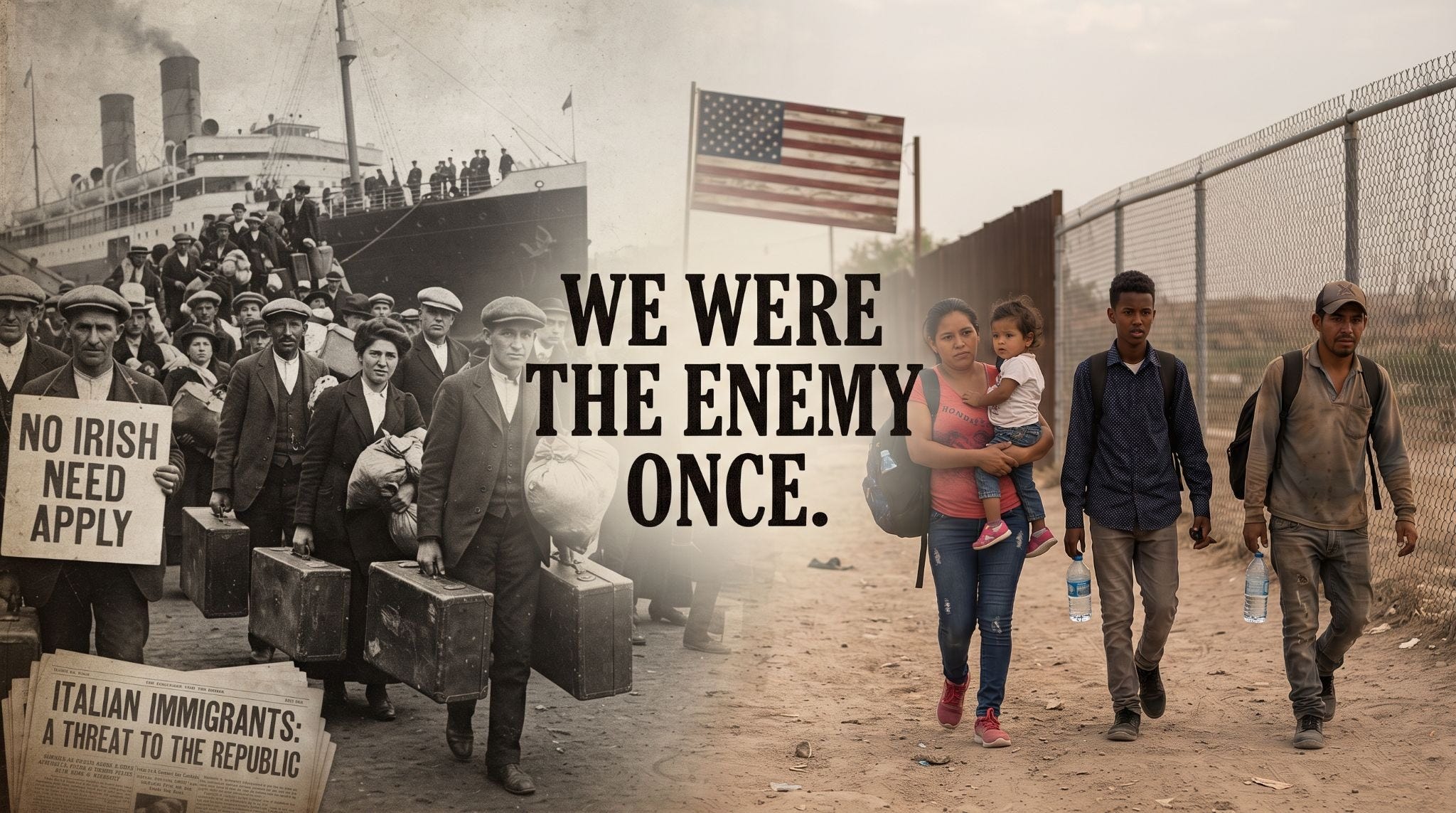
My people came off the boats poor, Catholic, and unwanted. Irish on one side, Italian on the other. And for two or three generations, the country that now flies my family’s name on its mailbox treated us as exactly the thing so many of my older relatives now fear: the invasion. The problem. The people who did not belong here and never would.
I want to lay out what actually happened to us, because the memory has been sanded down to St. Patrick’s Day parades and Sunday gravy. The real record is uglier, and it should be required reading for anyone in my own family who now looks at a Honduran mother or a Somali kid or a Mexican day laborer and sees a threat.
They said we couldn’t be American
The charge against the Irish and the Italians was that we were loyal to a foreign power. Catholics took orders from the Pope, the argument went, so we could never really be American. This wasn’t fringe talk. In the 1850s the Know Nothing party built a national movement on it, at its peak sending more than 100 congressmen, eight governors, and controlling several state legislatures to office. Their platform: no Catholic could hold office, and immigrants should wait 21 years to become citizens.
Read that residency number again. It was engineered. The point of the 21-year wait was to make sure recent Irish arrivals couldn’t vote for most of their working lives. Keep them here, take their labor, deny them the ballot. That was the design.
Boston posters called Catholics “vile imposters, liars, villains, and cowardly cutthroats.” A bestselling book claimed priests raped nuns and strangled the babies. It was a proven fraud. It sold hundreds of thousands of copies anyway, because the point of the lie was never truth. The point was to make people afraid enough to act.
They burned our churches and stopped us from voting
This is the part my family has forgotten. In 1834 a mob burned the Ursuline convent in Charlestown. In 1844 the Philadelphia nativist riots left thirteen dead and two Catholic churches torched. A Jesuit priest in Maine was tarred, feathered, and ridden out of town on a rail. Churches went down in Massachusetts, Maine, Connecticut.
And then there was Bloody Monday. August 6, 1855, election day in Louisville. Protestant mobs sealed off the polls to keep Irish and German Catholics from voting. Loaded cannons were rolled up and pointed at St. Martin’s Church. Of the more than 1,000 Catholics eligible to vote that day, only about 20 got a ballot in. By nightfall, 22 people were dead and parts of the city were ash. Five men were later indicted. None were convicted. The victims were never compensated.
Voter intimidation. Armed men at the polls demanding you say a password or turning you away for your accent or your clothes. This happened to people whose blood I carry. It happened because someone in power decided we were dangerous, and enough of their neighbors believed it.
They said the same words then that get said now
The Italians got it worse in some ways, because we were darker and we were southern. Through the 19th century and into the 20th, Italian immigrants were routinely called “white niggers.” In 1891 in New Orleans, after a police chief was murdered, a jury acquitted the Italian defendants. So a mob of thousands, including some of the city’s most prominent citizens, broke into the jail and lynched eleven Italian men. The largest mass lynching in American history, and the victims had been found not guilty.
The mayor of New Orleans had already described the newcomers as “the most idle, vicious, and worthless people among us,” filthy, diseased, and “without courage, honor, truth, pride, religion, or any quality that goes to make a good citizen.” Theodore Roosevelt, a future president, wrote privately that the lynching was “rather a good thing, and said so.” The New York Times ran an editorial calling Sicilians “sneaking and cowardly” descendants of bandits and declaring that lynch law was the only option.
Idle. Vicious. Criminal. Diseased. Can’t assimilate. Loyal to a foreign power. Breeding too fast. Now go turn on cable news tonight and count how long it takes to hear every one of those words again, pointed at somebody else.
They changed the law to keep us out
When the mobs weren’t enough, they wrote it into statute. Henry Cabot Lodge used the New Orleans killings to push a literacy test to screen out “the paupers and criminals of Europe” — meaning us. That test became law in 1917. Then came the National Origins Act of 1924, which set immigration quotas explicitly designed to choke off arrivals from Italy and Eastern Europe while keeping the door open for Northern Europeans. The law existed to make sure fewer people like my grandparents ever set foot here.
The tools were always the same. Slander to soften people up. Riots and lynchings when they wanted a message sent. Voter suppression to keep the newcomers powerless. And finally legislation to make the whole thing permanent. Marginalize, terrorize, disenfranchise, then codify. That is the playbook, and it has not changed. Only the target has.
Why they do it
Here is the thing my relatives need to sit with. None of this was really about the Irish or the Italians, any more than today’s version is really about Hondurans or Muslims. A politician learns early that the fastest way to bind a crowd together is to hand it something to hate. A common enemy does what no policy can: it makes scared, struggling people feel like a team. It turns a man who can’t pay his bills into a man with someone beneath him.
The Know Nothings didn’t rise because the Irish were dangerous. They rose because native-born Protestants were anxious about a changing country, and a movement offered them a villain instead of an answer. My family was that villain. We were cast as evil, as a problem, as people who deserved whatever they got — not because we were, but because someone’s power depended on us being seen that way.
Look in the mirror
So when I hear an older relative talk about the migrants at the border the way the New York Times once talked about my great-great-grandfather, I don’t get to pretend it’s a different thing. It’s the same thing. Same words, same fear, same men in power profiting from it. The only difference is that this time, my family is standing on the other side of the line, doing the pointing instead of getting pointed at.
We were let in. We were allowed to become white, to become “real” Americans, to forget that the country ever wanted us gone. That forgetting is the whole trick. It lets each new generation of the once-hated turn around and hate the next arrivals with a clear conscience.
I’m not willing to forget. My name is Irish and Italian and Catholic, and every one of those words was once an argument for keeping my people out, silencing them, or killing them. I know exactly what it looks like when a country decides some human beings are a problem to be solved. I’ve seen it in my own blood.
We were the enemy once. We should be the last people on earth willing to make someone else the enemy now.